by ©Mindnavy
Last week, we were discussing habits, discipline, and performance in one of our internal conversations at Mindnavy, and the discussion went in a direction we did not expect.
We were not talking about productivity tools. We were not talking about time management. We were not talking about strategy. We were talking about fasting.
And suddenly the conversation became much deeper than habits, food, or routines. We started talking about control.
Not control over others. Control over yourself.
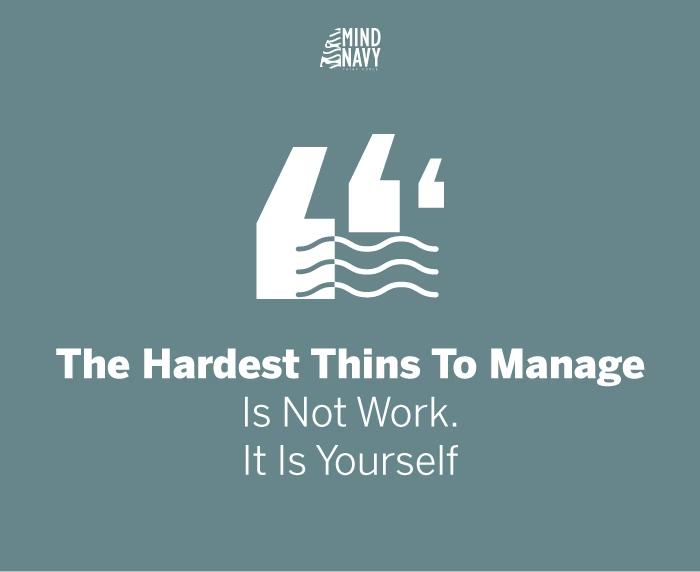
The Hardest Thing to Manage Is Not Work. It Is Yourself.
In organizations, people always want to learn:
- How to manage teams.
- How to communicate better.
- How to lead meetings.
- How to be more productive.
- How to build strategy.
But after years of working with teams, leaders, trainers, and organizations, we noticed something very simple:
The biggest problem in most workplaces is not lack of skills. It is not lack of intelligence. It is not lack of tools.
It is lack of self-management.
People struggle to manage:
- Their reactions
- Their emotions
- Their stress
- Their habits
- Their consistency
- Their focus
- Their energy
- Their behavior under pressure
And this is where discipline starts.
Not in your calendar. Not in your planner. Not in your task manager.
Discipline starts in your behavior.
Fasting Is Not About Food. It Is About Decisions.
What makes fasting interesting is not hunger or thirst.
What makes fasting interesting is this simple idea: You decide not to do something you are used to doing, even if you can.
No one is forcing you. No one is watching you all the time. You could easily break it and no one would know. But you don’t.
That is discipline. Discipline is not doing difficult things. Discipline is not doing easy things.
Read that again.
Most people think discipline is waking up at 5 AM, working hard, pushing, doing more, more, more. But real discipline is often much quieter:
- Not reacting when you are angry
- Not answering in a bad tone
- Not quitting something you started
- Not scrolling for one more hour
- Not spending money you don’t need to spend
- Not saying everything you think
- Not following your mood every day
Discipline is not loud. Discipline is silent.
Habits Are Built When No One Is Watching
People see success and think it comes from big decisions. It doesn’t. Success comes from very small decisions repeated many times:
- Finishing tasks.
- Showing up on time.
- Controlling reactions.
- Continuing when motivation disappears.
- Respecting your own commitments.
- Doing things even when you don’t feel like it.
No one claps for these things. No one posts about these things. No one celebrates these things.
But these things build a person. And that person builds a career, a team, a company, a reputation, a life.
Leadership Starts With Self-Leadership
At Mindnavy, we talk a lot about leadership. But one of the most important ideas we always repeat is this: Before you lead a team, you must lead yourself.
If you cannot control:
- Your reactions.
- Your habits.
- Your words.
- Your time.
- Your emotions.
- Your consistency.
Then leadership will always feel difficult, exhausting, and stressful. Because the hardest person you will ever manage is not your team. It is yourself.
The Discipline No One Sees Always Shows Later
Here is the interesting part about discipline.
At the beginning, no one sees it. No one rewards it. No one talks about it. Sometimes people don’t even understand it.
But later, everyone sees the results:
- The calm leader
- The organized person
- The reliable colleague
- The successful trainer
- The consistent entrepreneur
- The trusted manager
- The strong team
And people call it success, talent, personality, leadership, luck.
But very often, it is none of these.
It is just years of small discipline that no one saw.
Final Thought
Maybe discipline is not about working more. Maybe discipline is not about strict routines. Maybe discipline is not about pressure and intensity.
Maybe discipline is simply this:
Respecting the decisions you made for your life, even when you don’t feel like it anymore.
And maybe one of the strongest forms of discipline is not controlling your schedule, your team, or your work.
Maybe it is simply learning to control:
- your habits
- your reactions
- your words
- your emotions
- your impulses
- yourself
Because in the end, the person you are becoming is built in moments that no one sees.