Creating high-quality, engaging training or educational content has always been a demanding process. It requires subject-matter expertise, instructional design knowledge, pedagogical awareness, and hours of careful writing and structuring. As expectations increase, many trainers and educators turn to AI, hoping for a faster, easier way to produce content.
But most conversations around AI stop at its most basic function: using it as a content writer to draft lesson plans or summarize material.
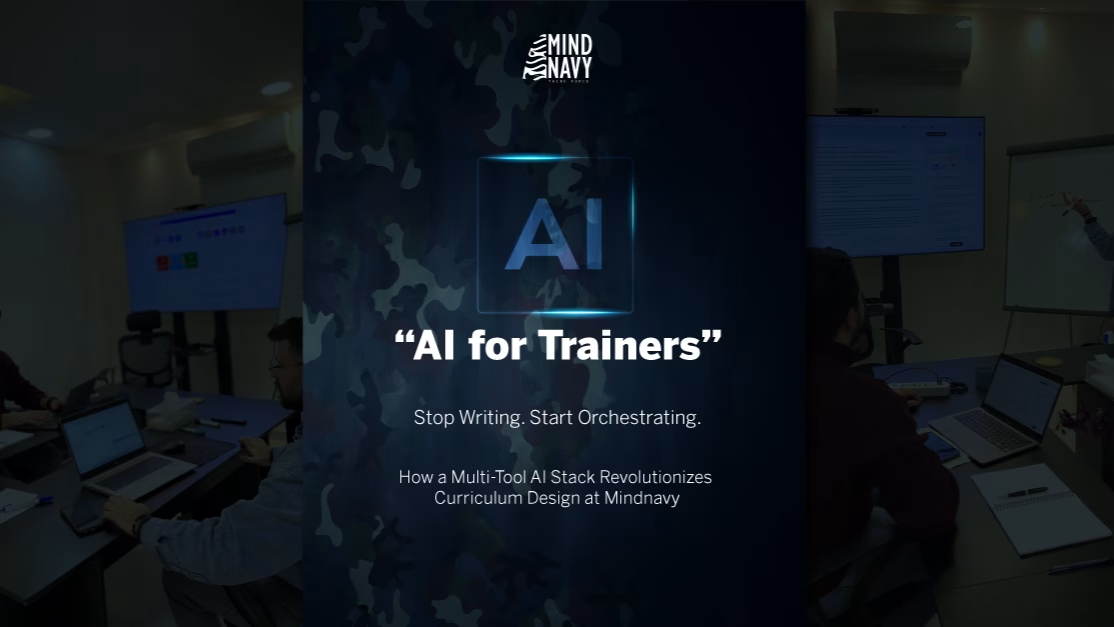
At Mindnavy, we train professionals to go beyond that. The real transformation happens when AI is treated not as a single tool, but as a team of specialized assistants; each performing a defined role within a structured workflow. This article outlines the exact multi-tool methodology Mindnavy teaches, and the six key shifts that move trainers from basic prompting to orchestrating AI-augmented curriculum design.
Your New Job Title Is Instructional Orchestrator
The first and most fundamental shift is a mindset shift.
In modern curriculum design, the goal is no longer to personally write every activity, slide, or document. Instead, the trainer evolves into an Instructional Orchestrator; the architect of the learning experience.
At Mindnavy, trainers learn how to:
- Define learning strategy and outcomes
- Curate and validate source materials
- Direct AI tools to execute specific tasks
- Focus their expertise on pedagogy, engagement, and learning impact
In practice, this means transforming raw research generated with Google Gemini into structured, pedagogically diverse curricula using Learnt.ai, then synthesizing everything into source-grounded facilitator manuals and participant handbooks using NotebookLM.
This shift moves trainers away from tactical writing and toward strategic orchestration.
You Don’t Need One AI Tool — You Need an AI Stack
A common mistake is searching for a single, all-powerful AI tool to handle every task. Mindnavy trains a professional alternative: building a multi-tool AI stack, where each phase of curriculum development is handled by the most suitable tool.
The curriculum design workflow taught at Mindnavy follows four clear phases:
Phase 1 – Research & Discovery
Phase 2 – Architecture & Pedagogy
Phase 3 – Synthesis & Reporting
Phase 4 – Visual Production
The Closed-Loop Workflow That Tames AI Hallucinations
One of the biggest risks in AI-assisted curriculum design is hallucination; when AI generates confident but inaccurate information.
Mindnavy addresses this risk through closed-loop workflows. Trainers upload only vetted research, structured lesson plans, and approved documents, then instruct the AI to rely exclusively on those sources.
This creates a controlled environment where AI cannot invent facts or sources. Instead, it becomes a reliable synthesis engine, dramatically increasing the integrity and trustworthiness of training materials.
Using AI to Design Variety, Not Monotony
There is a common fear that AI leads to repetitive and generic learning experiences. When used strategically, Mindnavy shows the opposite.
Through a multi-method lesson planning approach in Learnt.ai, trainers generate multiple versions of the same lesson:
- Case-based learning for critical thinking
- Game-based learning for engagement
- Experiential activities for hands-on practice
- Direct instruction for foundational knowledge
This gives facilitators a flexible library of options they can adapt in real time during live sessions. AI becomes a tool for intentional variety, ensuring learning remains dynamic and responsive.
The Human-in-the-Loop Audit Is Essential
No matter how advanced the AI stack, Mindnavy reinforces that human judgment is non-negotiable.
Every curriculum produced through this workflow undergoes a structured human audit that checks:
- Instructional alignment and learning progression
- Accuracy, ethics, and bias
- Facilitation feasibility and timing realism
- Visual clarity, brand consistency, and accessibility
AI accelerates production, but humans retain responsibility for quality, ethics, and learner experience.
Production Is Not the Finish Line — Delivery Is
The final insight Mindnavy trains for is that curriculum creation does not end with slides or manuals.
Using dynamic agenda tools like SessionLab, trainers learn to orchestrate live sessions by managing flow, timing, and energy in real time. This is combined with interactive tools such as Miro for collaboration and Slido for real-time engagement.
This transforms training from content delivery into experience design.
Your Augmented Future as a Trainer
The most effective use of AI in curriculum design is not about automating the human out of the process. It’s about augmenting human expertise through a structured, multi-tool system that assigns the right tasks to the right tools; while keeping strategic control in human hands.
By shifting from writer to orchestrator, building a dedicated AI stack, and maintaining rigorous human oversight, trainers can design higher-quality learning experiences faster and with greater consistency.
This is the methodology Mindnavy trains.
And once you understand this blueprint for AI-augmented curriculum design, the question becomes:
Which other high-impact training or communication workflow are you ready to orchestrate next?